

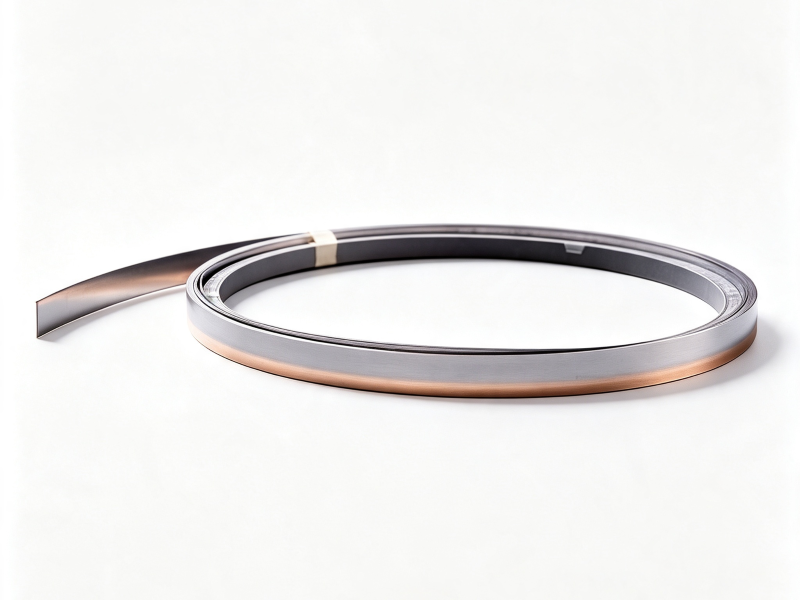
Clad Metal for Signal Relay
High-performance clad strips with precision layer thickness control and built-in demagnetization gaps provide a stable, automation-ready material solution for signal relays.
Technical data
| Product: | QSn/DT4E,C5191/DT4E | Strip Thickness: | 0.015–1.5 mm |
| Strip Width: | 3–100 mm | Cladding Layer Thickness: | 0.001–70% of total thickness |
| Cladding Layer Width: | 1–100 mm | Cladding Layer Tolerance: | +20% to -10% of cladding layer thickness |
| Performance: | Customized |
Features & Benefits
Metallurgical Bonding
Advanced roll-bonding integrates the C5191 phosphor bronze layer with the DT4E pure iron substrate at the atomic level. The interface is free from the heat-affected zones and brittle phases typical of conventional welding, delivering high bond strength and good fatigue resistance.
Bifunctional Design:
The C5191 surface layer offers good creep resistance and elastic contact performance, while the DT4E iron core ensures stable magnetic circuit conduction – balancing electrical contact reliability with magnetic response sensitivity.
Residual Magnetism Optimization:
The non-magnetic C5191 layer forms a low-reluctance bypass within the natural structure, effectively suppressing residual magnetism sticking after relay release and enhancing contact rebound crispness and action repeatability.
Near-Net-Shape Advantage:
The clad strip can be directly stamped into armature or yoke components, eliminating downstream welding of non-magnetic shims. This simplifies the process chain and reduces tolerance stack-up during multi-point assembly.
Miniaturization Ready:
The material offers dimensional stability and flat strip shape, making it particularly suitable for the miniaturization and high-density mounting trends in signal relays, meeting the demanding requirements of telecom and industrial control equipment for fast response and long service life.